HYDROCYCLONES
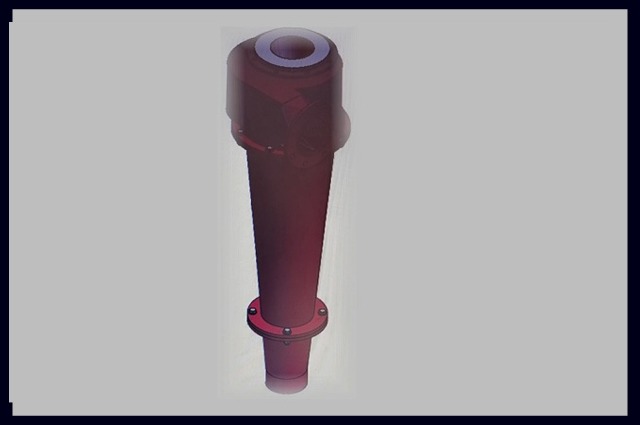
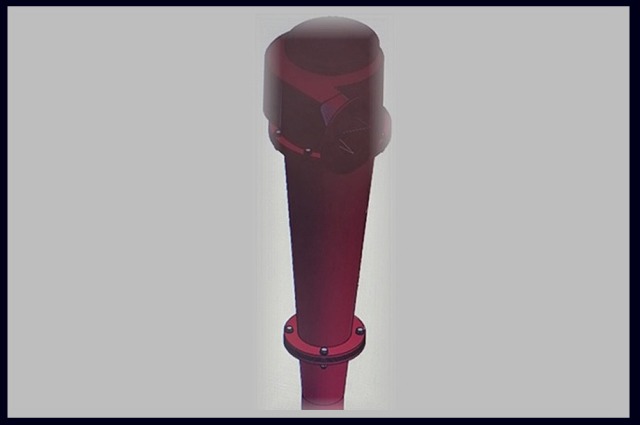
The general operation principle of the hydrocyclone is based on the terminal settling velocity of the particle in the centrifugal field generated against the gravitational field within the unit. Hydrocyclones is a constant volume unit that separates particles of a given specific density based on mass, that is, heavy particles report to the underflow and light particles to the overflow. The underflow will consist of coarse particles and high slurry density whereas the overflow has low slurry density and fine particles.
In milling circuits, the hydrocyclone receives feed from the mill discharge at a certain slurry density and separates into fine overflow and coarse underflow. The underflow is combined with fresh feed to form mill feed for further milling. On the other hand, the overflow with fine product is pumped to downstream processing such as flotation, gravity concentration through spirals and high intensity magnetic separation.
In tailing storage facilities (TSF), our tailing deposition cyclones are adequately suited for all TSF requirements. The typical overflow to underflow solids split 40% to 60%.
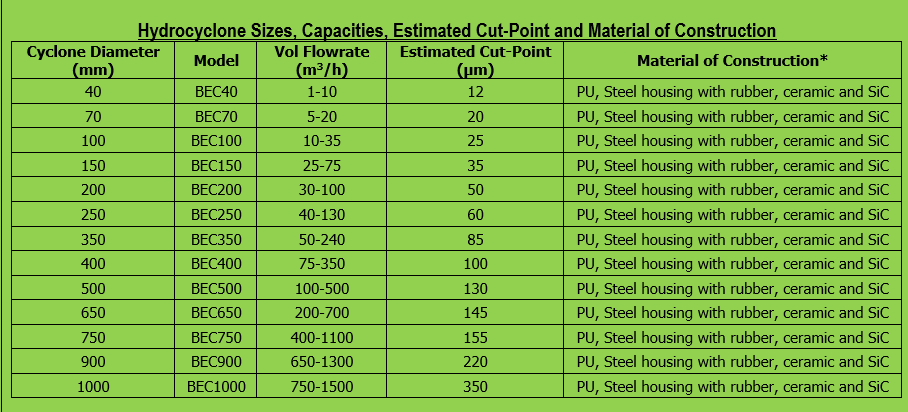
Our simulation program predicts process parameters such as cut point, efficiency factors, operating pressure as well as design parameters such as hydrocyclone diameter, vortex finder size, spigot size, free vortex finder height, Our hydrocyclone range include 40, 70, 100, 150, 200, 250, 350, 400, 500, 600, 700, 800, 900, 1000 mm diameter units with ceramic, silicon carbide, rubber, and polyurethane lining.